
Brain Gains (Rapid Recall, Jivin' Generation)

- Let $R$ be the region in space that lies inside the square with $-2\leq x\leq 2$ and $-2\leq y\leq 2$ and outside the circle $x^2+y^2=1$. Let $C_1$ be the curve that wraps around the square in a counter-clockwise fashion. Let $C_2$ be the curve that wraps around the circle in a counter-clockwise fashion. Let $\vec F (x,y) = \frac{(-y,x)}{x^2+y^2}$. Note that $\vec F$ is not defined at $(0,0)$.
- Draw the region $R$ and curves $C_1$ and $C_2$.
- Show that $N_x-M_y=0$ for $(x,y)\neq 0$.
- Let $D$ be the disc inside $C_2$. Why can we not use Green's theorem to compute $\ds\int_{C_2}Mdx+Ndy$ using $\iint_D N_x-M_ydA$?
- Compute $\ds\int_{C_2}Mdx+Ndy$ directly.
- Green's theorem states that $\ds\iint_R N_x-M_y dA = \int_{\partial R}Mdx+Ndy$, provided that $\vec F$ is continuously differentiable along all of the region $R$, and all curves in the boundary $\partial R$ are oriented so that the region $R$ is on the left. Use Green's theorem to explain why $\ds\int_{C_1}Mdx+Ndy = \int_{C_2}Mdx+Ndy$.
- Let $C_3$ be any simple closed piecewise smooth curve which does not pass through the origin. Explain why $\ds\int_{C_3}Mdx+Ndy = 2\pi$.
Solutions
I'll let you draw the square and circle.
We compute $$\begin{align*} N_x - M_y &= \frac{\partial}{\partial x}(\frac{y}{x^2+y^2}) - \frac{\partial}{\partial y}(\frac{x}{x^2+y^2}) \\ &= \frac{(x^2+y^2)(0)-(-y)(2x)}{(x^2+y^2)^2} - \frac{(x^2+y^2)(0)-(x)(2y)}{(x^2+y^2)^2} \\ &= 0. \end{align*}$$
Note that $\vec F$ is not defined at $(0,0)$, let alone differentiable there. We can't employ Green's theorem, as we would have to integrate $N_x-M_y$ over a region $D$ where $N_x-M_y$ is undefined. The region $R$ conveniently dodges the origin, but has two curves that make up its boundary.
We are on a circle of radius 1, so we know that $x^2+y^2=1$ and hence $F = (-y,x)$ when on this circle. Using the parametrization $\vec r(t) = (\cos t, \sin t)$ for $0\leq t\leq 2\pi$, we have $$\begin{align*} \int_{C_2}Mdx+Ndy &= \int_{C_2} (-y)dx+xdy \\ &= \int_{0}^{2\pi} (-(\sin t))(-\sin t)+(\cos t)(\cos t)dt \\ &= \int_{0}^{2\pi} 1 dt \\ &= 2\pi. \end{align*}$$
Because $N_x-M_y=0$ inside all of the region $R$ (the region $R$ does not contain $(0,0)$), we have that $$\ds\iint_R N_x-M_y dA = \int_{\partial R}Mdx+Ndy.$$ The boundary $\partial R$ consists of the two curves $C_1$ and $C_2$, but to make sure the region $R$ stays on the left side of each curve, we must traverse $C_2$ in a clockwise fashion. This gives $$\ds\iint_R N_x-M_y dA = [\int_{C_1}Mdx+Ndy] + [-\int_{C_2}Mdx+Ndy]. $$ Because $N_x-M_y=0$, then we have $$0 = [\int_{C_1}Mdx+Ndy] + [-\int_{C_2}Mdx+Ndy]. $$ We can rearrange the above to obtain $\int_{C_1}Mdx+Ndy = \int_{C_2}Mdx+Ndy.$
Let $C$ be any circle centered at the origin. The same argument above will show that $\int_{C}Mdx+Ndy = \int_{C_2}Mdx+Ndy=2\pi$. Now let $C_3$ be a simple closed piecewise smooth curve that does not pass through the origin. Pick a curve $C_4$ that is a circle centered around the origin with a radius small enough that the entire curve $C_4$ lies inside $C_3$. Then let $R$ be the region between $C_3$ and $C_4$. Because $N_x-M_y = 0$, Green's theorem again gives $0 = [\int_{C_3}Mdx+Ndy] + [-\int_{C_4}Mdx+Ndy],$ and because $\int_{C_4}Mdx+Ndy=2\pi$, we have $\int_{C_3}Mdx+Ndy]=2\pi$.
Carefully chosing a region $R$ on which $N_x-M_y=0$ was crucial to all the work above. We had to dodge the place where $\vec F$ was undefined. Stokes' theorem and the divergence theorem have similar parallels to this problem, and picking a region where the curl or divergence of a vector field are zero will let you swap out one region for another.
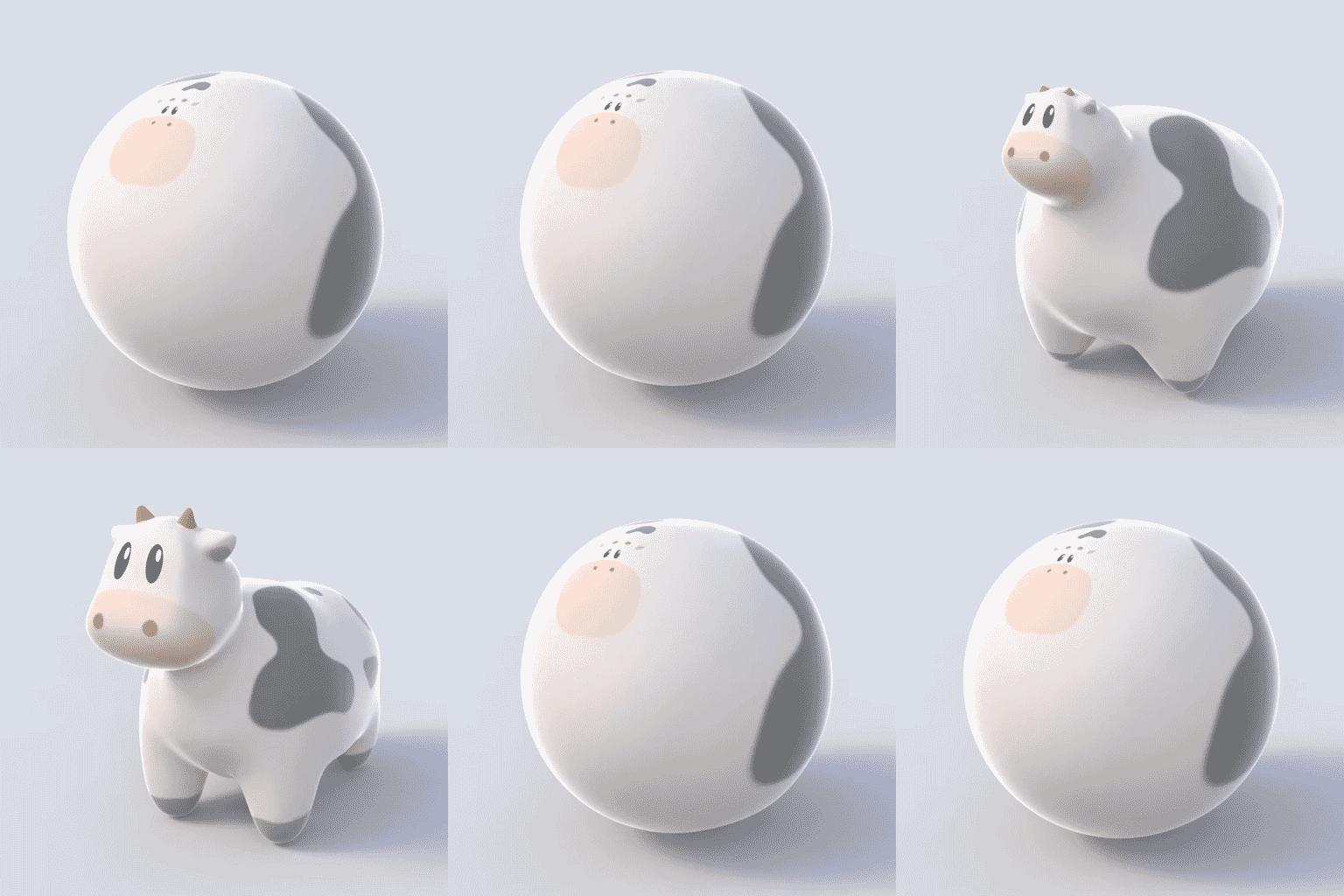
If we're lucky, we can assume a spherical cow (see https://en.wikipedia.org/wiki/Spherical_cow).
Group Problems
We'll spend most of the day letting people present what they've prepared. If we have time left at the end of class, we'll use it to tackle a problem that we haven't yet seen a solution to.